By Adam Halioua, founding partner, Goodman Halioua LLP
After a car accident in Ontario, many people receive a letter from their insurance company saying their injuries fall within the Minor Injury Guideline, often called the MIG. That decision limits the treatment your insurer will pay for to $3,500.
For many people, that isn’t enough. The good news is that the insurer’s decision isn’t final. If your injuries are more serious, or you had a health condition before the accident, you may be able to get out of the MIG and access more treatment funding.
What Is the Minor Injury Guideline?
The Minor Injury Guideline sets out the treatment your auto insurer will pay for if your injuries are considered “minor”. Under Ontario’s accident benefits rules, a minor injury generally includes:
- Sprains and strains
- Whiplash injuries
- Bruises (contusions), scrapes (abrasions) and cuts (lacerations)
- Subluxations (partial dislocations)
- Symptoms that are clinically associated with these injuries
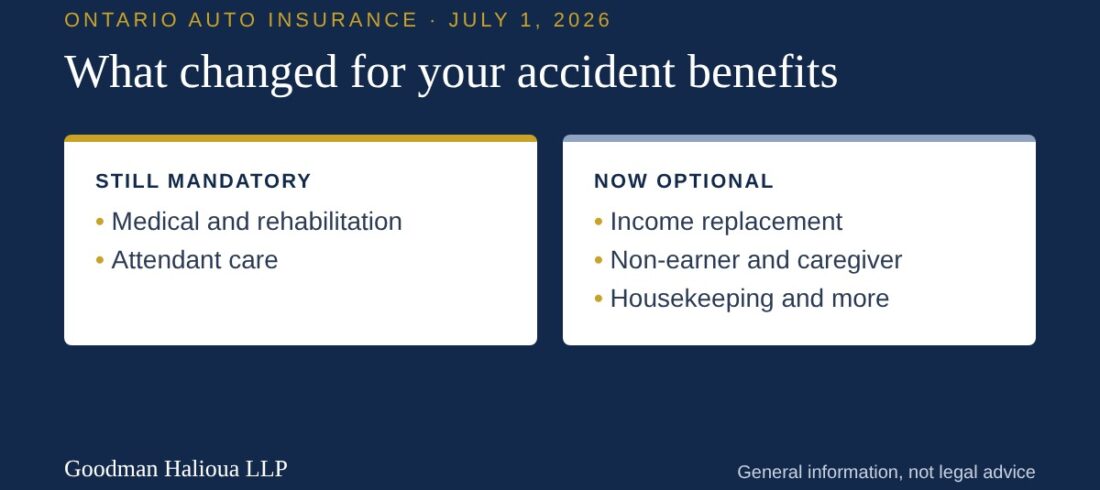
If your injuries fall within the MIG, your medical and rehabilitation benefits are capped at $3,500, compared with up to $65,000 for non-minor injuries. These limits are unchanged by the July 1, 2026 changes. → Read: Ontario’s July 1, 2026 accident benefits changes
Ways to Get Out of the MIG
1. Your injuries aren’t “minor”
Many accident injuries don’t fit within the MIG definition at all, for example:
- Fractures
- Concussions and other brain injuries. A concussion and its effects on your life may take you outside the MIG. → Brain injury and concussion claims
- Nerve damage, such as radiating pain, numbness or weakness from a pinched nerve
- Psychological injuries, such as depression, anxiety or post-traumatic stress disorder after the crash
- Chronic pain that continues well beyond the expected recovery period
2. A pre-existing condition
If you had a medical condition before the accident that will prevent you from achieving maximal recovery within the MIG, you may be removed from it. This must be documented by a health practitioner before the accident, for example in your family doctor’s records.
Examples can include a previous back or neck injury, arthritis, or a prior condition that slows healing. The key is evidence that the condition will stop you from recovering within the MIG’s limits.
The Evidence That Makes the Difference
Insurers decide MIG questions based on medical evidence. The evidence that most often helps includes:
- Your family doctor’s records, both before and after the accident
- Diagnostic imaging, such as X-rays, CT scans or MRIs
- Specialist reports, for example from a neurologist, physiatrist, orthopaedic surgeon, psychologist or psychiatrist
- Your treatment providers’ notes showing your symptoms aren’t resolving
- Your own records of how your symptoms affect your work and daily life
See your doctor promptly after an accident, and tell them about every symptom, including headaches, memory problems, sleep problems, anxiety and pain that spreads into your arms or legs. Symptoms that aren’t recorded are hard to prove later.
How to Dispute a MIG Decision
If your insurer places you in the MIG and you disagree:
- Ask your doctor or treatment provider to explain in writing why your injuries fall outside the MIG, or why a pre-existing condition will stop you from recovering within it.
- Submit treatment plans for the care you need, with supporting medical evidence.
- Ask the insurer to reconsider, with the new evidence.
- If the insurer still refuses, you can apply to the Licence Appeal Tribunal, generally within 2 years of the denial.
Getting legal advice early helps. The right medical evidence, gathered at the right time, is often what decides these disputes.
How the MIG Affects Your Lawsuit
Being placed in the MIG for accident benefits doesn’t decide whether you can sue the at-fault driver. A lawsuit for pain and suffering has its own legal test, the threshold, and a deductible. → See the 2026 threshold and deductible amounts
That said, the same medical evidence often matters for both claims, which is why we handle them together.
Frequently Asked Questions
What happens when the $3,500 runs out?
If you’re in the MIG and reach the $3,500 limit, your auto insurer won’t fund more treatment unless you’re removed from the MIG. You may still have coverage through a workplace or private health plan.
My insurer put me in the MIG right away. Is that final?
No. Insurers often place claims in the MIG early, before the full extent of the injuries is known. If new evidence shows your injuries are more serious, or you had a qualifying pre-existing condition, you can ask to be removed.
Does a concussion fall under the MIG?
A concussion and its effects on your life may take you outside the MIG, giving you access to more treatment funding. Medical evidence is key.
Do I need a lawyer to get out of the MIG?
Not always, but insurers often dispute these requests, and the evidence and deadlines matter. A free consultation can help you understand your options.
Talk to a Lawyer
Stuck in the Minor Injury Guideline? Our founding partners offer a free, confidential consultation to review your injuries, your medical evidence and your options. We come to you if you can’t come to us.
Book a free consultation | 416-367-4642
This article provides general information, not legal advice. Every situation is different. Contact a lawyer about your specific circumstances.