By Adam Halioua, founding partner, Goodman Halioua LLP
If you’ve been seriously injured in a car accident in Ontario, one of the most important decisions in your accident benefits claim is whether you are “catastrophically impaired”. A catastrophic impairment finding can mean the difference between a $65,000 limit for treatment and care, and up to $1,000,000.
It is also one of the most disputed decisions in accident benefits claims. This guide explains what catastrophic impairment means, who can qualify, how it’s assessed, and what to do if your insurer says no.
Why a Catastrophic Impairment Finding Matters
If you’re found catastrophically impaired, you can access a higher tier of accident benefits:
| Benefit | Non-catastrophic | Catastrophic impairment |
|---|---|---|
| Medical, rehabilitation and attendant care (combined) | Up to $65,000, generally for up to 5 years | Up to $1,000,000, for life |
| Attendant care | Up to $3,000 per month | Up to $6,000 per month |
These are the standard limits. They can be higher if optional benefits were purchased on the policy.
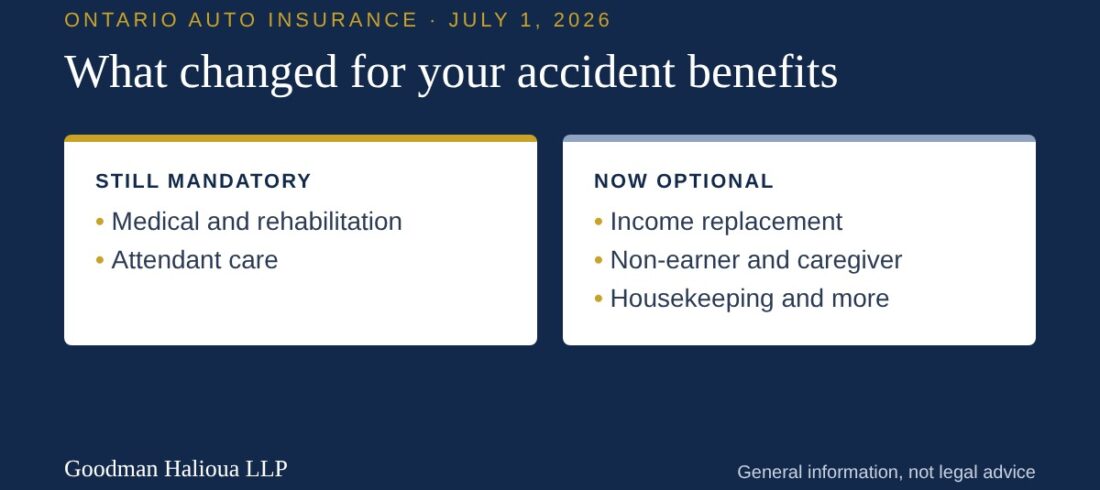
A catastrophic impairment finding can also give access to housekeeping and home maintenance benefits and caregiver benefits. These work the same way as before, except that for accidents on or after July 1, 2026, both are optional benefits that are only available if they were purchased on the policy. → Read: Ontario’s July 1, 2026 accident benefits changes
Who Can Qualify
Ontario’s accident benefits rules (section 3.1 of the Statutory Accident Benefits Schedule, for accidents on or after June 1, 2016) set out specific criteria. A person is catastrophically impaired if they meet any one of them:
1. Paraplegia or tetraplegia
- A permanent grade of A, B or C on the ASIA Impairment Scale, or
- A permanent grade of D (an incomplete injury) together with one of: very limited ability to move around indoors (a score of 0 to 5 on the Spinal Cord Independence Measure, Mobility Indoors), the need for surgical diversion, an implanted device or catheterization to manage bladder function, or impaired bowel control that requires a bowel routine, surgical diversion or an implanted device.
2. Amputation or severe impairment of walking or an arm
- Amputation of a leg at or above the lower leg (trans-tibial or higher)
- Amputation of an arm, or the total and permanent loss of use of an arm
- A severe and permanent change to one or both legs that leaves the person with very limited ability to move around indoors (a score of 0 to 5 on the Spinal Cord Independence Measure, Mobility Indoors)
3. Loss of vision in both eyes
Even with corrective lenses or medication, visual acuity of 20/200 or less in both eyes, or a field of vision of 20 degrees or less in both eyes.
4. Traumatic brain injury (adults)
For people 18 or older at the time of the accident, the brain injury must show on a CT scan, MRI or other recognised brain imaging, and result in one of these ratings on the Glasgow Outcome Scale – Extended:
- Vegetative state, assessed one month or more after the accident
- Upper or lower severe disability, assessed six months or more after the accident
- Lower moderate disability, assessed one year or more after the accident
→ Brain injury and concussion claims
5. Traumatic brain injury (children)
For people under 18 at the time of the accident, any one of these:
- Admission as an in-patient to a designated public hospital, with brain imaging showing injury from the accident
- Admission as an in-patient to a neurological rehabilitation program at a paediatric rehabilitation facility
- A vegetative state on the King’s Outcome Scale for Childhood Head Injury one month or more after the accident, or severe disability six months or more after the accident
- Nine months or more after the accident, the child is not age-appropriately independent and needs in-person supervision or help for most of the day
6. Combined whole-person impairment of 55% or more
People with several injuries, or injuries that don’t meet any single criterion above, can qualify if their impairments reach 55% or more whole-person impairment under the AMA Guides. This can be based on physical impairments alone, or on a combination of physical and mental or behavioural impairments (not including traumatic brain injury).
7. Mental or behavioural impairment
A mental or behavioural disorder, such as PTSD or depression after a crash, that results in a marked impairment in three or more areas of function, or an extreme impairment in one or more areas, that prevents useful functioning.
When You Can Apply: the Time Periods
The time periods in the regulation are an important part of the strategy:
| Criterion | Earliest it can apply |
|---|---|
| Adult brain injury: vegetative state | 1 month after the accident |
| Adult brain injury: severe disability | 6 months after the accident |
| Adult brain injury: lower moderate disability | 1 year after the accident |
| Child brain injury | 1, 6 or 9 months after the accident, depending on the criterion |
| 55% whole-person impairment | 2 years after the accident, or earlier if a physician assesses the person 3 months or more after the accident and finds the impairment is at least 55% and unlikely to improve below 55% |
| Marked or extreme mental or behavioural impairment | 2 years after the accident, or earlier if a physician states in writing that the impairment is unlikely to improve below the required level |
| Spinal cord injury, amputation and loss of vision | When the permanent condition can be determined |
For children whose impairment doesn’t meet the criteria above, the regulation also allows a catastrophic impairment finding where it can reasonably be believed that the impairment is catastrophic, by comparison with the closest adult criterion.
How Catastrophic Impairment Is Assessed
- The application. Your doctor or another qualified health professional completes an application for a catastrophic impairment determination (form OCF-19) and submits it to your insurer, with supporting medical evidence.
- The insurer’s examinations. The insurer usually arranges its own assessments by health professionals it chooses.
- The decision. The insurer accepts or denies the application.
- Disputes. If the insurer denies it, you can apply to the Licence Appeal Tribunal, generally within 2 years of the denial.
Timing matters. Applying before the required time has passed, or before your condition has stabilised, can lead to a denial. Applying with the right assessments at the right time makes a real difference.
Why Insurers Dispute Catastrophic Impairment
Because a catastrophic impairment finding can increase an insurer’s exposure from $65,000 to $1,000,000 or more, these applications are often contested. Common points of dispute include:
- Whether the injury was caused by the accident, or by a pre-existing condition
- How impairments are rated and combined under the AMA Guides
- Whether psychological impairments should be included
- Whether the assessments were done at the right time
The strength of your medical evidence, and how it’s presented, is often what decides the outcome. → Read: Surviving the catastrophic impairment determination process
How We Help
- We assess early whether your injuries may meet a catastrophic impairment criterion, and plan the evidence from the start.
- We work with the right professionals, including neurologists, neurosurgeons, physiatrists, neuropsychologists, psychologists, psychiatrists and occupational therapists, to document your impairments.
- We time the application so the assessments reflect your true condition.
- We challenge denials at the Licence Appeal Tribunal when the insurer gets it wrong.
- We coordinate your claims. A catastrophic impairment finding affects your accident benefits and your lawsuit against the at-fault driver, so we handle them together.
Frequently Asked Questions
Can an incomplete spinal cord injury be catastrophic?
Yes. An incomplete injury can meet the catastrophic impairment criteria through the spinal cord injury rules, a severe impairment of walking, or combined impairments of 55% or more whole-person impairment.
Can psychological injuries count?
Yes. A mental or behavioural impairment can qualify on its own if it results in a marked impairment in three or more areas of function, or an extreme impairment in one or more areas, and psychological impairments can be combined with physical ones toward the 55% whole-person impairment test.
When should I apply?
It depends on the criterion. Some brain injury criteria can apply as early as one month after the accident; the 55% whole-person and mental or behavioural criteria generally require two years, unless a physician confirms earlier that the impairment is unlikely to improve. Getting legal advice early helps you choose the right time.
What if my insurer denies my application?
You can dispute the decision at the Licence Appeal Tribunal, generally within 2 years of the denial. Many denials are overturned with the right medical evidence.
Does a catastrophic impairment finding affect my lawsuit?
The accident benefits test and the test for suing the at-fault driver are different. But the two claims interact: the accident benefits you receive or are entitled to, including the higher catastrophic benefits, can affect the damages awarded in your lawsuit. The same medical evidence also often matters for both. That’s why we handle them together from the start.
Talk to a Lawyer
Seriously injured in a car accident? Our founding partners offer a free, confidential consultation to review your injuries and whether you may qualify for catastrophic impairment benefits. We come to you, in hospital, at a rehabilitation centre or at home.
Book a free consultation or call 416-367-4642
This article provides general information, not legal advice. Every situation is different. Contact a lawyer about your specific circumstances.